Author: Javier Morales

  • Internal Linking Strategy: How to Build a Strong Link Structure for SEO

    Internal Linking Strategy: How to Build a Strong Link Structure for SEO

    Internal linking is one of the most underutilized SEO tactics. While everyone focuses on building backlinks, the links within your own site often get ignored — even though you have complete control over them.

    A solid internal linking strategy helps search engines understand your site structure, distributes authority to important pages, and keeps users engaged longer. I’ve seen sites significantly improve their rankings just by fixing their internal link structure.

    This guide covers everything you need to know about internal linking for SEO in 2026 — from the fundamentals to advanced strategies you can implement today.
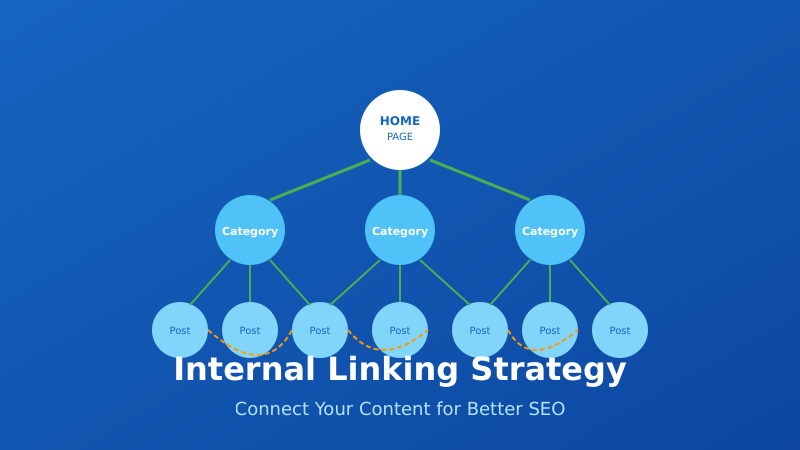
    Internal Linking Strategy - Connect Your Content for Better SEO

    What Are Internal Links?

    Internal links are hyperlinks that point from one page on your website to another page on the same website. They’re different from external links (which point to other websites) and backlinks (which come from other websites to yours).

    Examples of internal links:

    • Navigation menus — Links in your header, footer, and sidebar
    • Contextual links — Links within your content that point to related pages
    • Breadcrumbs — Navigation showing the page’s location in site hierarchy
    • Related posts — Links to similar content at the end of articles
    • Category/tag links — Links to taxonomy archive pages

    Contextual links (links within your main content) are the most valuable for SEO because they carry more weight than navigational links.

    Why Internal Linking Matters for SEO
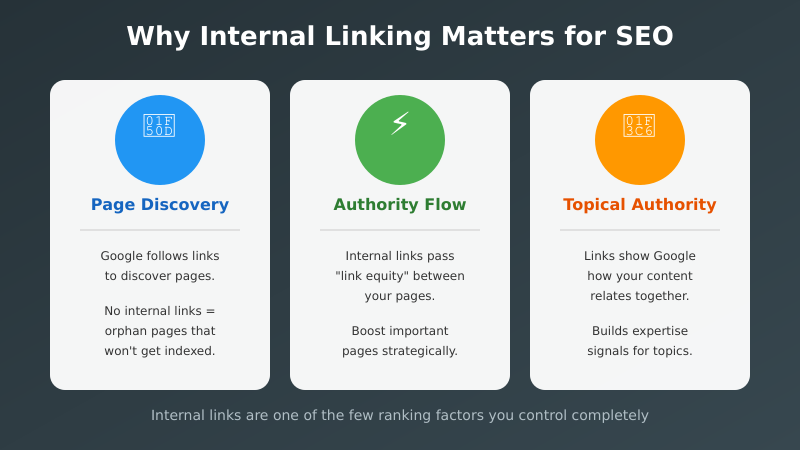
    Why Internal Linking Matters - Page Discovery, Authority Flow, and Topical Authority

    Internal links serve three critical functions for search engine optimization:

    1. Help Search Engines Discover Pages

    Google discovers new pages by following links. If a page has no internal links pointing to it (an “orphan page”), Google may never find it — or take much longer to index it.

    Your XML sitemap helps with discovery, but internal links are still essential for showing Google which pages are important.

    2. Distribute Link Authority (PageRank)

    When a page earns backlinks, it gains authority. Internal links pass some of that authority to other pages on your site. This is sometimes called “link equity” or “link juice.”

    Strategic internal linking lets you channel authority from high-performing pages to pages you want to rank better. Your homepage typically has the most authority — linking from it to important pages boosts their ranking potential.

    3. Establish Topical Authority

    Internal links help Google understand the relationships between your pages. When you link related content together, you signal topical expertise.

    In 2026, with AI-powered search becoming more prevalent, logical content architecture is even more important. Search engines and AI systems need to understand how concepts on your site relate to each other.

    Internal Linking Strategies
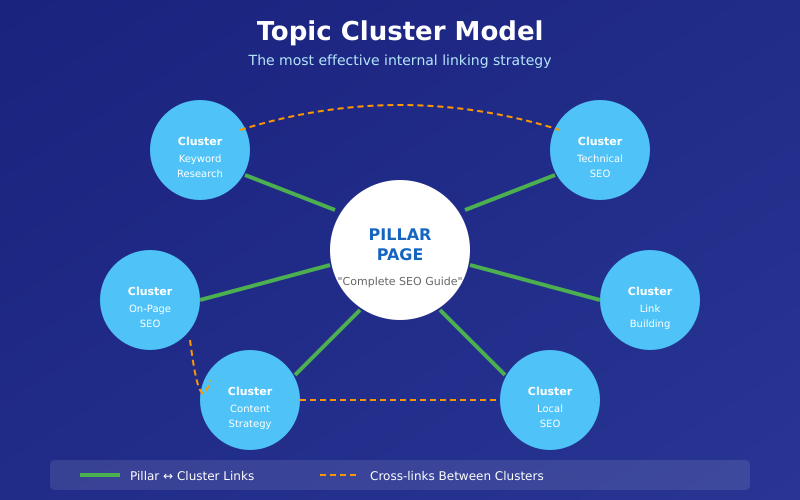
    Topic Cluster Model - The Most Effective Internal Linking Strategy

    There are several approaches to structuring your internal links. The best strategy depends on your site type and goals.

    Topic Clusters (Hub and Spoke)

    The most effective modern approach is the topic cluster model:

    • Pillar page — A comprehensive guide covering a broad topic
    • Cluster pages — Supporting articles that dive deep into subtopics
    • Internal links — The pillar links to all cluster pages, and they link back

    Example: A pillar page about “SEO” links to cluster pages about keyword research, technical SEO, link building, on-page optimization, etc. Each cluster page links back to the pillar and to related cluster pages.

    This structure:

    • Establishes topical authority
    • Creates clear content hierarchy
    • Distributes authority efficiently
    • Helps users find related content

    Silo Structure

    Similar to topic clusters, but more rigid. Content is organized into strict categories (silos), and pages only link within their silo — not across silos.

    This works well for large sites with distinct product categories or service areas. It keeps topical relevance tight but can feel artificial if overdone.

    Cornerstone Content

    Identify your most important pages (cornerstone content) and ensure they receive the most internal links. These are typically:

    • Your best, most comprehensive content
    • Pages targeting your most valuable keywords
    • Pages you most want to rank

    Every time you publish related content, link to your cornerstone pages. This concentrates authority where it matters most.

    Internal Linking Best Practices
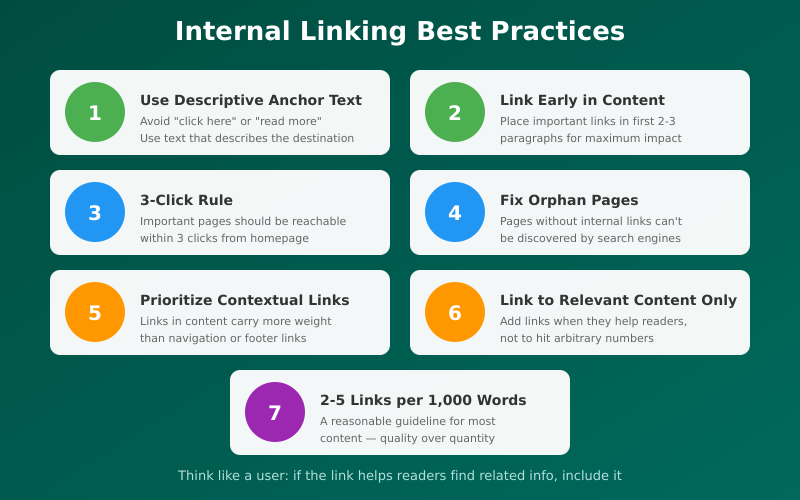
    Internal Linking Best Practices - 7 Key Guidelines

    Follow these guidelines for maximum impact:

    1. Use Descriptive Anchor Text

    Anchor text is the clickable text of a link. It should describe what the linked page is about.

    Good: “Learn more about technical SEO audits
    Bad: “Learn more here

    Descriptive anchor text helps both users and search engines understand the destination page’s topic. Avoid generic phrases like “click here,” “read more,” or “this article.”

    2. Link Early in Content

    Google gives more weight to links that appear earlier on a page. Place your most important internal links within the first 2-3 paragraphs when possible.

    This also improves user engagement — readers are more likely to click links they encounter early.

    3. Keep Important Pages Within 3 Clicks

    Users (and search engines) should be able to reach any important page within 3 clicks from your homepage. This is sometimes called “crawl depth.”

    Deep pages (many clicks from homepage) receive less authority and may be crawled less frequently. If you have important content buried deep in your site structure, add more internal links to bring it closer to the surface.

    4. Fix Orphan Pages

    Orphan pages have no internal links pointing to them. They’re difficult for Google to discover and typically don’t rank.

    Use tools like Screaming Frog to identify orphan pages, then add internal links to them from relevant content.

    5. Prioritize Contextual Links

    Links within your main content (contextual links) carry more weight than links in navigation, sidebars, or footers. These “boilerplate” links appear on every page, so they’re less valuable signals.

    Focus on adding relevant contextual links within your articles and pages.

    6. Link to Relevant Content Only

    Only link when it makes sense for the reader. Forced or irrelevant links hurt user experience and can confuse search engines about your page topics.

    Ask yourself: “Would a reader find this link helpful?” If not, don’t add it.

    7. Use a Reasonable Number of Links

    There’s no magic number, but a good guideline is 2-5 internal links per 1,000 words. More is fine if they’re all relevant, but don’t stuff links just to hit a number.

    Too many links dilute the authority passed to each one and can overwhelm readers.

    How to Audit Your Internal Links
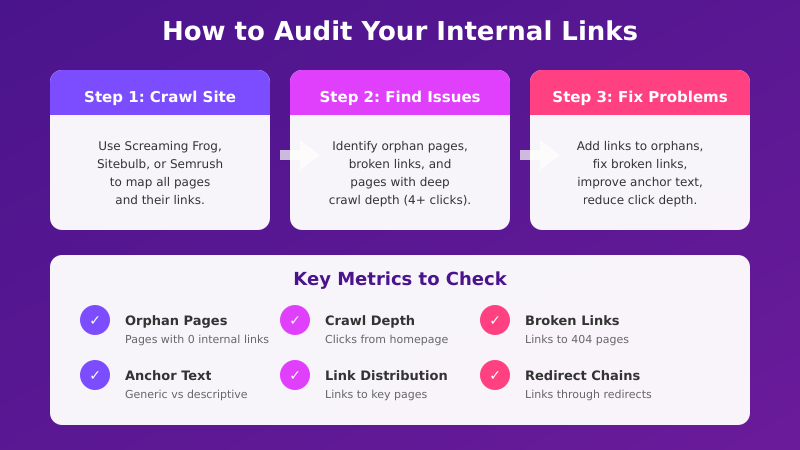
    How to Audit Your Internal Links - Step by Step Process

    Regular audits help you identify and fix internal linking issues. Here’s how to conduct one:

    Step 1: Crawl Your Site

    Use a crawler like Screaming Frog, Sitebulb, or Semrush to map all your pages and their internal links. This gives you a complete picture of your link structure.

    Step 2: Find Orphan Pages

    Look for pages with zero internal links pointing to them. These need to be connected to your site structure.

    Step 3: Identify High-Authority Pages

    Check Google Search Console or your analytics to find pages with the most backlinks or traffic. These are your authority sources — make sure they link to pages you want to boost.

    Step 4: Check Crawl Depth

    Find pages that are more than 3 clicks from your homepage. Either add more links to reduce depth, or evaluate whether these pages are still important.

    Step 5: Review Anchor Text

    Look for generic anchor text (“click here,” “read more”) and replace with descriptive text. Also check for over-optimized anchors (exact-match keywords used excessively).

    Step 6: Fix Broken Internal Links

    Identify links pointing to pages that no longer exist (404 errors) or redirect. Update them to point to the correct URLs. Learn more about finding and fixing broken links.

    Internal Linking Tools

    These tools help you analyze and improve your internal link structure:

    ToolBest ForPrice
    Screaming FrogComprehensive site crawlingFree (500 URLs) / £199/year
    SemrushInternal link audit reportsFrom $139/month
    AhrefsLink opportunity suggestionsFrom $129/month
    SitebulbVisual link structure analysisFrom $13.50/month
    Link WhisperWordPress internal link suggestions$77/year
    Yoast SEOBasic WordPress linking featuresFree / $99/year

    For most sites, Screaming Frog’s free version combined with Google Search Console provides enough data to audit and improve internal linking.

    Common Internal Linking Mistakes

    Avoid these frequent errors:

    Orphan Pages

    Pages with no internal links can’t pass a technical SEO audit. Every important page needs at least one internal link pointing to it.

    Generic Anchor Text

    “Click here” and “read more” waste an opportunity to signal relevance. Use descriptive text that tells users and search engines what to expect.

    Broken Links

    Links to deleted or moved pages hurt user experience and waste crawl budget. Audit regularly and fix promptly.

    Too Many Links

    Stuffing pages with links dilutes authority and overwhelms readers. Link when relevant, not to hit arbitrary numbers.

    Ignoring New Content

    When you publish new content, don’t just add links from it — also update older content to link to the new page. This two-way linking accelerates indexing and authority building.

    Linking Only from Navigation

    Navigation links are important but not sufficient. Contextual links within content carry more SEO weight.

    FAQ

    How many internal links should I have per page?

    There’s no fixed number. A good guideline is 2-5 links per 1,000 words, but quality matters more than quantity. Add links when they help the reader find relevant content. Don’t force links just to hit a target number.

    Should I use nofollow on internal links?

    Almost never. Nofollow tells search engines not to pass authority through the link. For internal links, you want authority to flow freely. The only exception might be links to login pages or other pages you don’t want indexed.

    Do internal links help with rankings?

    Yes. Internal links help search engines discover pages, understand site structure, and distribute authority. Pages with more quality internal links typically rank better than orphan pages, assuming the content quality is similar.

    Should anchor text be exact match keywords?

    Not always. Use natural, descriptive anchor text that includes relevant keywords but reads naturally. Varying your anchor text looks more natural than using the exact same phrase every time. Over-optimization can look spammy.

    How often should I audit internal links?

    For most sites, quarterly audits work well. Larger sites that publish frequently might benefit from monthly checks. At minimum, audit whenever you delete pages or make significant structural changes.

    Final Thoughts

    Internal linking is one of the few SEO factors you control completely. You don’t need to convince anyone to link to you — you just need to link to yourself strategically.

    Start with the basics: fix orphan pages, use descriptive anchor text, and ensure important pages are within 3 clicks of your homepage. Then build out topic clusters to establish topical authority.

    The key is to think like a user. Link when it helps readers find related information. If your internal links make sense for humans, they’ll make sense for search engines too.

    I audit internal links as part of every SEO project. Small improvements to link structure often deliver surprisingly large ranking gains — it’s one of the highest-ROI activities in SEO.
  • XML Sitemap Guide: What It Is and How to Create One

    XML Sitemap Guide: What It Is and How to Create One

    An XML sitemap is one of the most fundamental — yet often misunderstood — elements of technical SEO. It’s a simple file that can significantly improve how search engines discover and index your content.

    I’ve set up sitemaps for hundreds of websites over the years. This guide covers everything you need to know: what XML sitemaps are, why they matter, how to create one, and the best practices that actually make a difference in 2026.

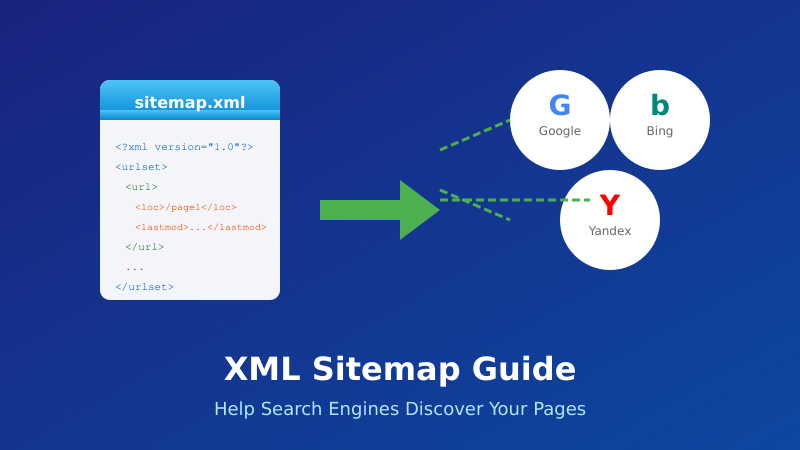
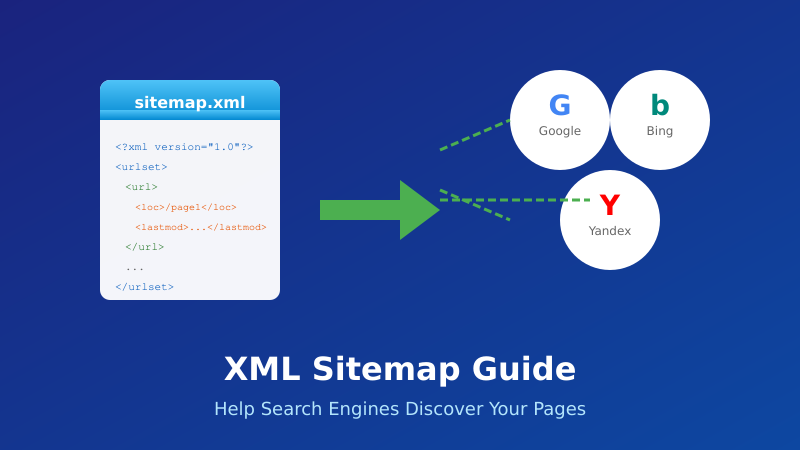
    XML Sitemap Guide - Help Search Engines Discover Your Pages

    What Is an XML Sitemap?

    An XML sitemap is a file that lists all the important URLs on your website. It acts as a roadmap for search engine crawlers, telling them what pages exist and where to find them.

    Here’s what a basic XML sitemap looks like:

    <?xml version="1.0" encoding="UTF-8"?>
    <urlset xmlns="http://www.sitemaps.org/schemas/sitemap/0.9">
      <url>
        <loc>https://example.com/</loc>
        <lastmod>2026-01-10</lastmod>
      </url>
      <url>
        <loc>https://example.com/about/</loc>
        <lastmod>2026-01-05</lastmod>
      </url>
    </urlset>

    The sitemap file is typically located at yoursite.com/sitemap.xml.

    XML Sitemap Elements

    ElementRequiredDescription
    <loc>YesThe full URL of the page
    <lastmod>NoLast modification date (YYYY-MM-DD)
    <changefreq>NoHow often page changes (ignored by Google)
    <priority>NoRelative importance 0.0-1.0 (ignored by Google)

    Important: Google ignores <changefreq> and <priority> values. Focus on accurate <lastmod> dates instead — Google does use these when they’re reliable.

    Why Do You Need an XML Sitemap?

    Search engines can discover your pages through links, but a sitemap makes the process faster and more reliable.

    You Especially Need a Sitemap If:

    • Your site is large — Thousands of pages are harder to crawl completely
    • Your site is new — Few external links mean crawlers may not find all pages
    • You have orphan pages — Pages without internal links pointing to them
    • You use rich media — Video and image sitemaps help with media indexing
    • You publish frequently — New content gets discovered faster
    • Your site has deep architecture — Pages many clicks from homepage

    Benefits of XML Sitemaps

    • Faster indexing — New pages get discovered quicker
    • Better crawl efficiency — Crawlers know exactly what to index
    • Visibility into indexing — Search Console shows sitemap coverage
    • Support for all content types — Images, videos, news articles

    Types of Sitemaps

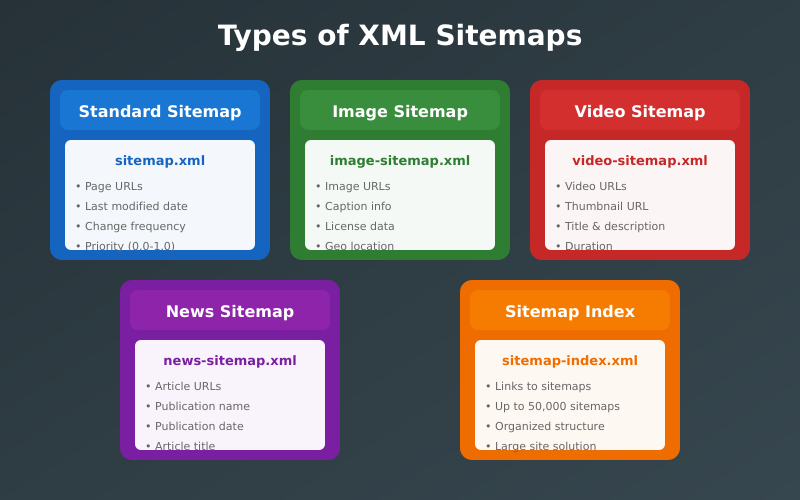
    Types of XML Sitemaps - Standard, Image, Video, News, and Sitemap Index

    There are several types of sitemaps, each serving different purposes:

    1. XML Sitemap (Standard)

    The most common type. Lists your website’s pages for search engines. This is what most people mean when they say “sitemap.”

    2. Sitemap Index

    A master file that references multiple sitemaps. Required when you have more than 50,000 URLs or your sitemap exceeds 50MB.

    <sitemapindex xmlns="http://www.sitemaps.org/schemas/sitemap/0.9">
      <sitemap>
        <loc>https://example.com/sitemap-posts.xml</loc>
      </sitemap>
      <sitemap>
        <loc>https://example.com/sitemap-pages.xml</loc>
      </sitemap>
    </sitemapindex>

    3. Image Sitemap

    Helps Google discover images that might not be found through crawling (like images loaded via JavaScript).

    4. Video Sitemap

    Provides metadata about videos on your site — title, description, duration, thumbnail. Essential for video SEO.

    5. News Sitemap

    For Google News publishers. Includes articles published within the last 48 hours.

    6. HTML Sitemap

    A user-facing page (not XML) that lists links to all pages. Helps visitors navigate but less important for SEO than XML sitemaps.

    How to Create an XML Sitemap

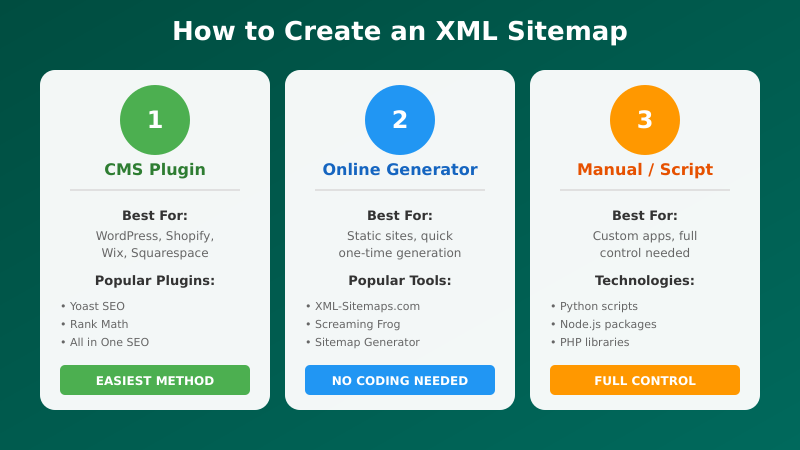
    How to Create an XML Sitemap - CMS Plugin, Online Generator, and Manual Methods

    There are several ways to create a sitemap depending on your platform and technical skills.

    Method 1: WordPress Plugins (Easiest)

    If you use WordPress, plugins handle everything automatically:

    Yoast SEO (Recommended)

    • Install and activate Yoast SEO
    • Go to Yoast SEO → Settings → Site Features
    • Ensure “XML sitemaps” is enabled
    • Your sitemap is at yoursite.com/sitemap_index.xml

    Rank Math

    • Install and activate Rank Math
    • Go to Rank Math → Sitemap Settings
    • Configure which post types to include
    • Your sitemap is at yoursite.com/sitemap_index.xml

    Both plugins automatically update your sitemap when you publish, edit, or delete content.

    Method 2: Built-in CMS Features

    Many platforms generate sitemaps automatically:

    • Shopify — Automatic at /sitemap.xml
    • Wix — Automatic at /sitemap.xml
    • Squarespace — Automatic at /sitemap.xml
    • Webflow — Automatic at /sitemap.xml

    Check your platform’s documentation — most modern CMS platforms include this feature.

    Method 3: Online Sitemap Generators

    For static sites or one-time generation:

    Limitation: Static sitemaps become outdated when you add or remove pages. You’ll need to regenerate manually.

    Method 4: Manual Creation

    For small sites or complete control, create the XML file manually:

    • Create a file named sitemap.xml
    • Add the XML structure with your URLs
    • Upload to your root directory
    • Update manually when content changes

    Only recommended for very small, rarely-updated sites.

    How to Submit Your Sitemap

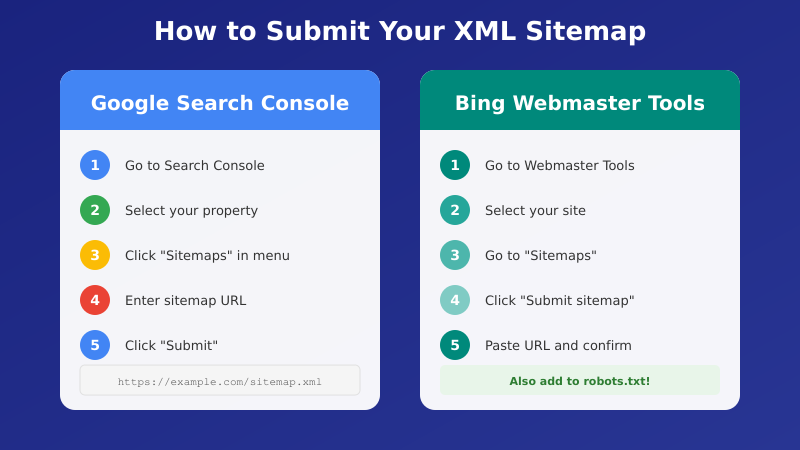
    How to Submit Your XML Sitemap to Google Search Console and Bing Webmaster Tools

    Once created, submit your sitemap to search engines for faster discovery.

    Google Search Console

    • Go to Google Search Console
    • Select your property
    • Navigate to Sitemaps in the left menu
    • Enter your sitemap URL (e.g., sitemap.xml)
    • Click Submit

    Google will show the submission status and how many URLs were discovered.

    Bing Webmaster Tools

    robots.txt Method

    You can also reference your sitemap in robots.txt. Add this line:

    Sitemap: https://yoursite.com/sitemap.xml

    This helps any crawler that reads robots.txt discover your sitemap automatically.

    XML Sitemap Best Practices

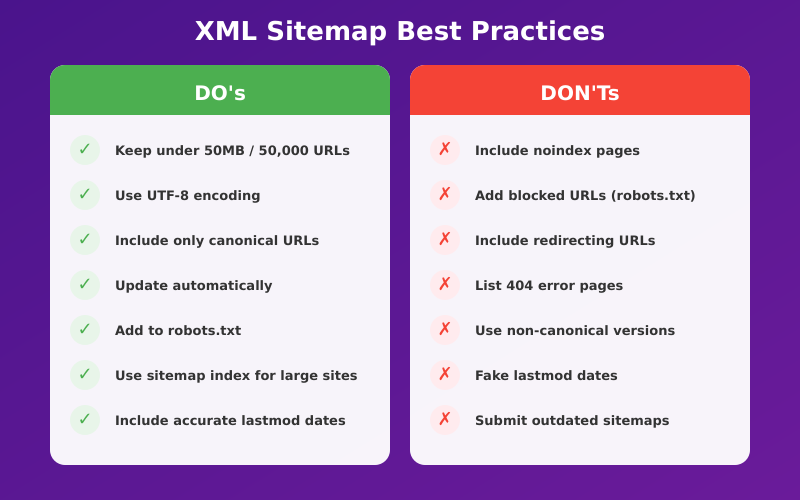
    XML Sitemap Best Practices - Do's and Don'ts

    Follow these guidelines for an effective sitemap:

    1. Only Include Indexable Pages

    Your sitemap should only contain pages you want indexed:

    • Don’t include noindex pages
    • Don’t include redirected URLs
    • Don’t include pages blocked by robots.txt
    • Don’t include duplicate content (use canonical URLs only)

    2. Use Absolute URLs

    Always use full URLs including the protocol:

    Correct: https://example.com/page/
    Wrong: /page/

    3. Keep URLs Consistent

    Use the same URL format throughout:

    • Choose www or non-www (stick to one)
    • Choose trailing slash or no trailing slash (stick to one)
    • Always use HTTPS

    4. Keep It Under Size Limits

    • Maximum 50,000 URLs per sitemap
    • Maximum 50MB file size (uncompressed)
    • Use a sitemap index for larger sites

    5. Use Accurate lastmod Dates

    Only update <lastmod> when page content actually changes. Google trusts accurate dates but will ignore them if they’re unreliable.

    6. Use UTF-8 Encoding

    Ensure your sitemap uses UTF-8 encoding and properly escapes special characters:

    • & becomes &amp;
    • ' becomes &apos;
    • " becomes &quot;

    Common Sitemap Mistakes

    Avoid these common errors:

    Including Non-Canonical URLs

    If page A canonicals to page B, only include page B in your sitemap. Including both creates confusion.

    Including Noindex Pages

    Pages with noindex meta tags shouldn’t be in your sitemap. You’re telling Google to both find and ignore the same page — mixed signals.

    Including Redirects

    Redirected URLs (301, 302) shouldn’t be in your sitemap. Include only the final destination URLs.

    Not Updating the Sitemap

    Static sitemaps become outdated quickly. Use dynamic generation (CMS plugins) or regenerate regularly.

    Wrong URL Protocol

    If your site uses HTTPS, your sitemap must list HTTPS URLs. HTTP URLs in an HTTPS sitemap create problems.

    Checking Your Sitemap

    After creating your sitemap, verify it works correctly:

    1. Access It Directly

    Visit yoursite.com/sitemap.xml in your browser. You should see XML content, not an error page.

    2. Validate the XML

    Use a validator to check for syntax errors:

    3. Check Search Console

    After submitting, monitor the Sitemaps report for:

    • Number of URLs discovered vs. indexed
    • Any errors or warnings
    • Last read date

    FAQ

    Does every website need an XML sitemap?

    Technically no. Small sites with good internal linking may not need one. But there’s no downside to having one, and it provides visibility into indexing through Search Console. I recommend creating one for every site.

    Will a sitemap guarantee my pages get indexed?

    No. A sitemap helps Google discover your pages, but it doesn’t guarantee indexing. Google still decides whether each page is worth indexing based on quality, relevance, and other factors.

    How often should I update my sitemap?

    Ideally, automatically whenever content changes. If using a CMS plugin, this happens automatically. For static sitemaps, regenerate whenever you add, remove, or significantly update pages.

    Should I include images and videos in my sitemap?

    For most sites, a standard XML sitemap is sufficient — Google finds images and videos when crawling your pages. Dedicated image/video sitemaps are mainly useful if your media content is important for search (e.g., stock photo sites, video platforms).

    Can I have multiple sitemaps?

    Yes. You can have separate sitemaps for different content types (posts, pages, products) and link them via a sitemap index file. This is common for large sites and helps with organization.

    Final Thoughts

    XML sitemaps are a simple but essential part of technical SEO. They help search engines discover your content faster and give you visibility into indexing through Search Console.

    For most sites, the easiest approach is using your CMS’s built-in feature or an SEO plugin like Yoast or Rank Math. These automatically generate and update your sitemap whenever content changes.

    Once created, submit it to Google Search Console and Bing Webmaster Tools. Then check back periodically to ensure there are no errors and that your pages are being discovered.

    Remember: a sitemap is just one piece of the SEO puzzle. It helps with discovery, but your content still needs to be valuable and your site technically sound for pages to actually rank.

    I set up XML sitemaps as part of every website launch and SEO audit. This guide reflects the current best practices I use for my own sites and client work.

  • How to Find and Fix Broken Links on Your Website

    How to Find and Fix Broken Links on Your Website

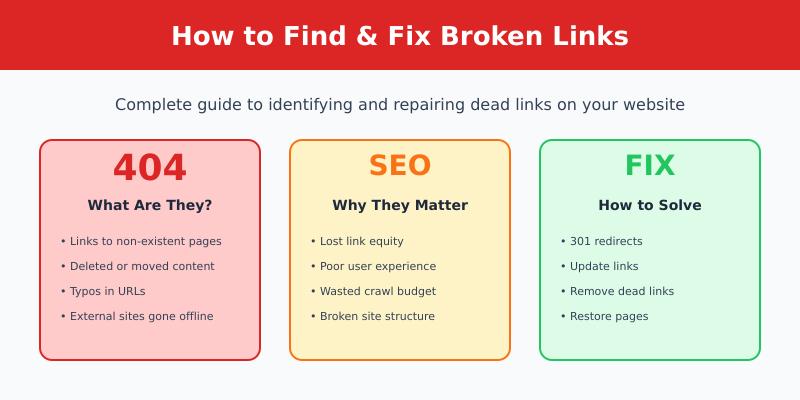
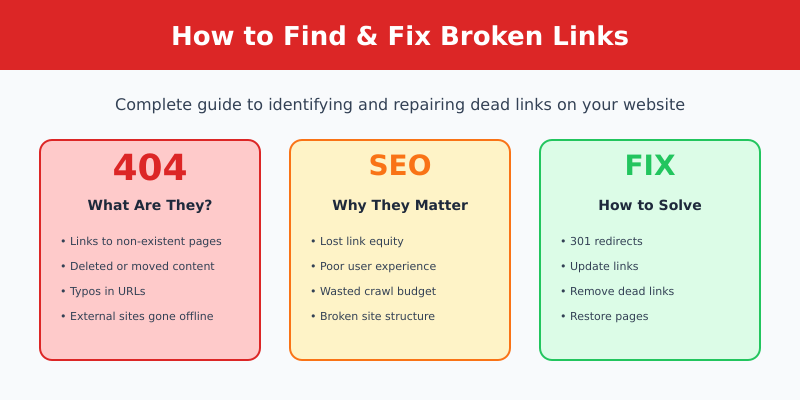
    Broken links are one of the most common — and most overlooked — SEO issues. They frustrate visitors, waste crawl budget, and leak the link equity you’ve worked hard to build.

    I’ve audited hundreds of websites, and almost every one has broken links hiding somewhere. The good news? They’re easy to find and fix once you know where to look.

    This guide covers everything: what broken links are, why they matter, how to find them using free tools, and exactly how to fix each type.

    How to Find and Fix Broken Links - Complete Guide

    What Are Broken Links?

    A broken link (also called a “dead link”) is a hyperlink that points to a page or resource that no longer exists or can’t be accessed. When someone clicks a broken link, they see an error page instead of the content they expected.

    The most common error is the 404 Not Found page, but broken links can return other errors too:

    Error CodeMeaningCommon Cause
    404Page not foundPage deleted or URL changed
    410Gone (permanently)Content intentionally removed
    500Server errorServer-side problems
    503Service unavailableServer overload or maintenance
    TimeoutNo responseServer too slow or offline

    Internal vs External Broken Links

    Internal broken links point to pages on your own website that no longer exist. These are fully within your control to fix.

    External broken links point to other websites. The linked page may have been deleted, moved, or the entire site might be gone. You can’t fix the destination, but you can update or remove the link.

    Why Broken Links Matter for SEO

    Why Broken Links Hurt Your SEO

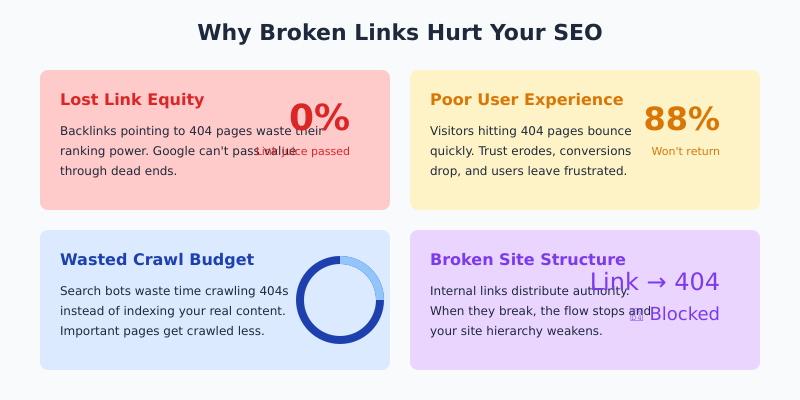
    Broken links hurt your website in several ways:

    1. Lost Link Equity

    When external sites link to a page that returns a 404, you lose the “link juice” (ranking power) those backlinks provide. Google can’t pass value through a dead end.

    This is especially painful if you have quality backlinks pointing to pages you’ve deleted or moved without redirects.

    2. Poor User Experience

    Nothing frustrates visitors more than clicking a link and hitting a dead end. Broken links:

    • Increase bounce rates
    • Reduce time on site
    • Damage trust and credibility
    • Lead to lost conversions

    3. Wasted Crawl Budget

    Search engine bots have limited time to crawl your site. Every time they hit a 404, they waste crawl budget that could be spent indexing your actual content.

    For large sites, this can mean important pages get crawled less frequently.

    4. Broken Internal Linking

    Internal links help distribute page authority throughout your site. When internal links break, that flow of authority stops, weakening your site structure.

    What Causes Broken Links?

    Understanding the causes helps prevent future broken links:

    • Deleted pages — Content removed without setting up redirects
    • URL changes — Permalinks changed without redirects
    • Typos — Mistyped URLs when creating links
    • Site migration — Moving to a new domain or CMS without proper redirects
    • External site changes — Other websites delete or move their content
    • Domain expiration — Linked websites go offline permanently
    • Incorrect relative URLs — Links that worked in one location but break when content moves

    How to Find Broken Links

    6 Ways to Find Broken Links

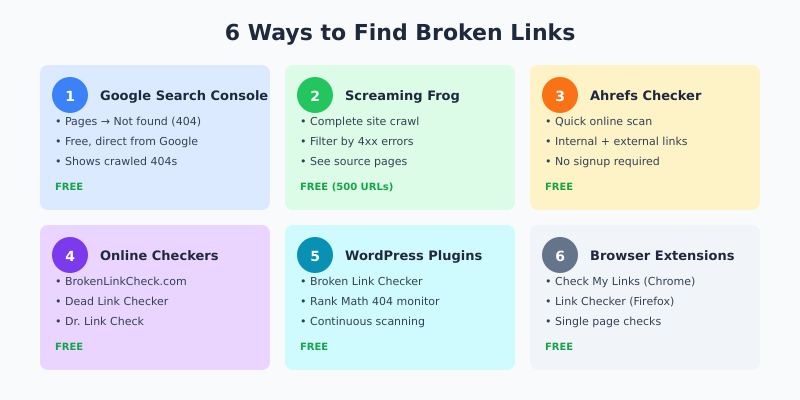
    There are several methods to find broken links on your website, from quick online checks to comprehensive site crawls.

    Method 1: Google Search Console (Free)

    Google Search Console reports crawl errors including 404 pages that Google’s bot has encountered.

    How to check:

    • Go to Google Search Console
    • Navigate to Pages (formerly Index Coverage)
    • Click on Not found (404) in the “Why pages aren’t indexed” section
    • Review the list of 404 URLs

    Limitation: Only shows pages Google tried to crawl — doesn’t catch all internal broken links.

    Method 2: Screaming Frog (Free up to 500 URLs)

    Screaming Frog SEO Spider crawls your entire site and identifies all broken links — both internal and external.

    How to check:

    • Download and open Screaming Frog
    • Enter your website URL and click Start
    • Wait for the crawl to complete
    • Click Response Codes tab
    • Filter by Client Error (4xx)
    • Click any broken URL, then check the Inlinks tab to see which pages link to it

    This is my preferred method because you see exactly which pages contain the broken links.

    Method 3: Ahrefs Broken Link Checker (Free)

    Ahrefs Broken Link Checker is a free online tool that quickly scans any website for broken links.

    How to use:

    • Enter your domain
    • Click “Check broken links”
    • Review the results showing broken internal and external links

    Quick and easy, but limited depth compared to a full crawl.

    Method 4: Online Broken Link Checkers

    Several free online tools can scan your site for broken links:

    These are good for quick checks but may miss links on JavaScript-heavy pages.

    Method 5: WordPress Plugins

    If you use WordPress, dedicated plugins can monitor your site for broken links:

    • Broken Link Checker — Monitors posts, pages, and comments for broken links
    • Rank Math — Includes 404 monitoring in the free version
    • Yoast SEO Premium — Redirects manager helps fix broken links

    Warning: The Broken Link Checker plugin can slow down your site if you have lots of content. Consider running it periodically rather than continuously.

    Method 6: Browser Extensions

    For checking individual pages:

    • Check My Links (Chrome) — Highlights broken links on any page
    • Link Checker (Firefox) — Similar functionality for Firefox users

    Great for spot-checking important pages after updates.

    How to Fix Broken Links

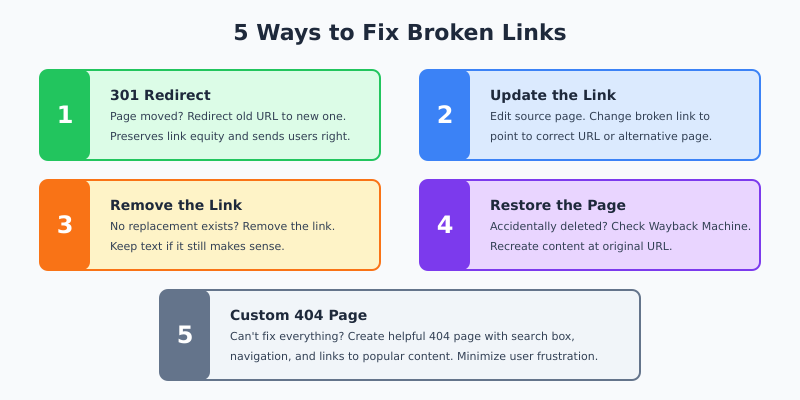
    5 Ways to Fix Broken Links

    Once you’ve found broken links, here’s how to fix them based on the situation:

    Fix 1: Set Up 301 Redirects

    If you moved or renamed a page, redirect the old URL to the new one. This preserves link equity and sends visitors to the right place.

    In WordPress:

    • Use Rank Math’s redirect manager (free)
    • Use Yoast SEO Premium’s redirect feature
    • Use the Redirection plugin (free)

    In .htaccess (Apache):

    Redirect 301 /old-page/ https://yoursite.com/new-page/

    In nginx:

    rewrite ^/old-page/$ /new-page/ permanent;

    Fix 2: Update the Link

    If you have internal links pointing to a deleted page, update them to point to a relevant existing page.

    Steps:

    • Find all pages linking to the broken URL (Screaming Frog’s Inlinks tab helps)
    • Edit each page
    • Update the link to point to the correct URL

    For external broken links, either find the new URL (check if the page moved) or link to an alternative resource.

    Fix 3: Remove the Link

    If the linked content no longer exists and there’s no suitable replacement, remove the link entirely. Keep the surrounding text if it still makes sense.

    Fix 4: Restore the Page

    If a page was accidentally deleted and has valuable backlinks, consider restoring it:

    • Check the Wayback Machine for archived versions
    • Recreate the content
    • Publish at the original URL

    This recovers the lost link equity from existing backlinks.

    Fix 5: Create a Custom 404 Page

    You can’t fix every broken link, especially external ones pointing to your site. A helpful 404 page minimizes frustration:

    • Acknowledge the error
    • Provide a search box
    • Link to popular pages or categories
    • Include navigation to help visitors find what they need

    Best Practices for Preventing Broken Links

    Prevention is easier than fixing. Follow these practices to minimize broken links:

    1. Always Redirect When Deleting or Moving Pages

    Before deleting any page, check if it has:

    • Backlinks (check in Google Search Console or Ahrefs)
    • Internal links pointing to it
    • Organic traffic

    If yes, set up a redirect to a relevant page before removing it.

    2. Use Absolute URLs

    Prefer full URLs (https://yoursite.com/page/) over relative URLs (/page/). Absolute URLs are less likely to break during site changes.

    3. Check Links Before Publishing

    Before publishing any content, verify that all links work. Use browser extensions like “Check My Links” for quick verification.

    4. Run Regular Audits

    Schedule periodic broken link audits:

    • Small sites: Monthly
    • Medium sites: Bi-weekly
    • Large sites: Weekly or continuous monitoring

    5. Be Careful with External Links

    External links are beyond your control. To minimize issues:

    • Link to authoritative, established websites
    • Avoid linking to pages likely to change (product pages, news articles)
    • Prefer linking to main pages rather than deep internal pages

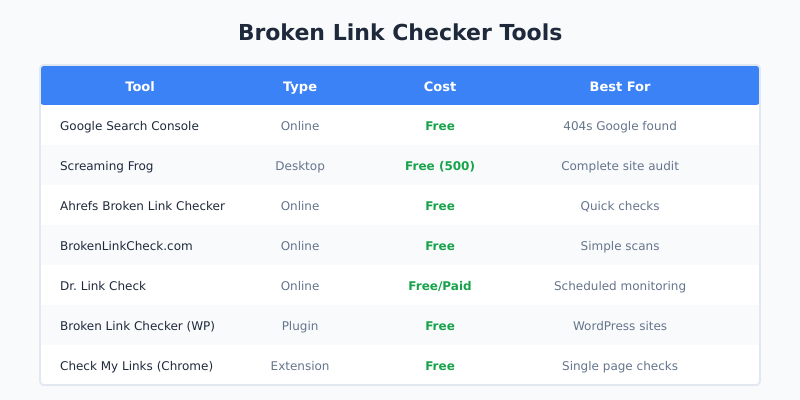
    Broken Link Checker Tools Comparison

    Broken Link Checker Tools Comparison
    ToolTypeCostBest For
    Google Search ConsoleOnlineFree404s Google found
    Screaming FrogDesktopFree (500 URLs)Complete site audit
    Ahrefs Broken Link CheckerOnlineFreeQuick checks
    BrokenLinkCheck.comOnlineFreeSimple scans
    Dr. Link CheckOnlineFree/PaidScheduled monitoring
    Broken Link Checker (WP)PluginFreeWordPress sites
    Check My LinksExtensionFreeSingle page checks

    FAQ

    Do broken links hurt SEO?

    Yes. Broken internal links waste crawl budget and break your site’s link structure. Broken pages that have backlinks lose the ranking value those links provide. Google has confirmed that excessive 404 errors can indicate poor site quality.

    How many broken links are too many?

    Even one broken link on an important page is too many. For the overall site, aim for zero broken links to internal pages. Some broken external links are inevitable over time, but fix them when discovered.

    Should I use 301 or 302 redirects for broken links?

    Use 301 (permanent) redirects in almost all cases. A 301 tells search engines the page has permanently moved and passes link equity to the new URL. Only use 302 (temporary) if you genuinely plan to restore the original page soon.

    How often should I check for broken links?

    At minimum, monthly. Large or frequently updated sites should check weekly. After any major site changes (redesign, migration, URL restructure), do a complete broken link audit immediately.

    What if I can’t find a replacement for a broken external link?

    Check the Wayback Machine to see what the page contained. Then either find similar content elsewhere to link to, or remove the link and adjust the surrounding text. Don’t leave broken links just because you can’t find a perfect replacement.

    Final Thoughts

    Broken links accumulate over time on every website. External sites change, pages get deleted, URLs get updated — it happens. The key is catching and fixing them before they harm your SEO and user experience.

    Start with Google Search Console to see what Google has already found. Then run a complete crawl with Screaming Frog for the full picture. Set up 301 redirects for moved content, update links to deleted pages, and create a helpful 404 page for anything you can’t fix.

    Make broken link audits part of your regular SEO maintenance. It’s one of those small tasks that compounds over time — fix them now, and you won’t have a massive cleanup job later.

    I find and fix broken links as part of every technical SEO audit. This guide reflects the process I use for my own sites and client work.

  • Best Free SEO Tools in 2026 (Complete List)

    Best Free SEO Tools in 2026 (Complete List)

    You don’t need to spend hundreds of dollars on SEO tools to improve your rankings. Some of the best SEO tools are completely free — and I use many of them daily.

    After 10+ years in digital marketing, I’ve tested dozens of SEO tools. This guide covers the ones that actually deliver value without costing a penny. Whether you’re doing keyword research, technical audits, or backlink analysis, there’s a free tool for the job.

    Let’s dive into the complete list.

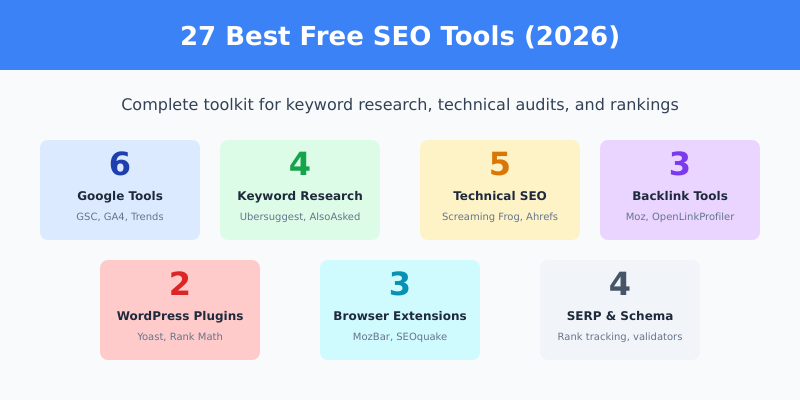
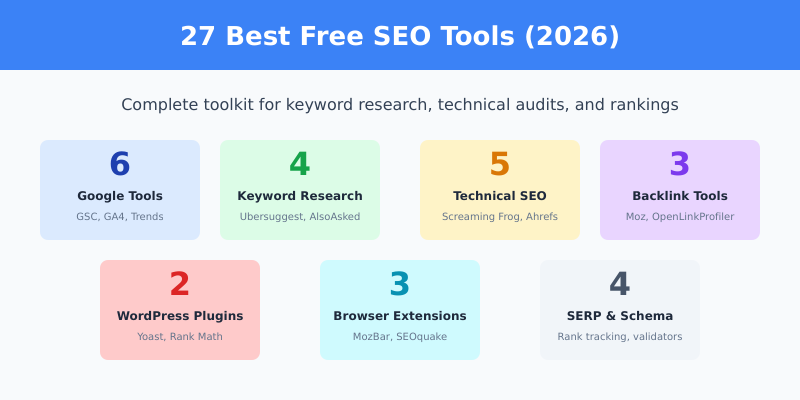
    27 Best Free SEO Tools 2026 - Complete Toolkit Overview

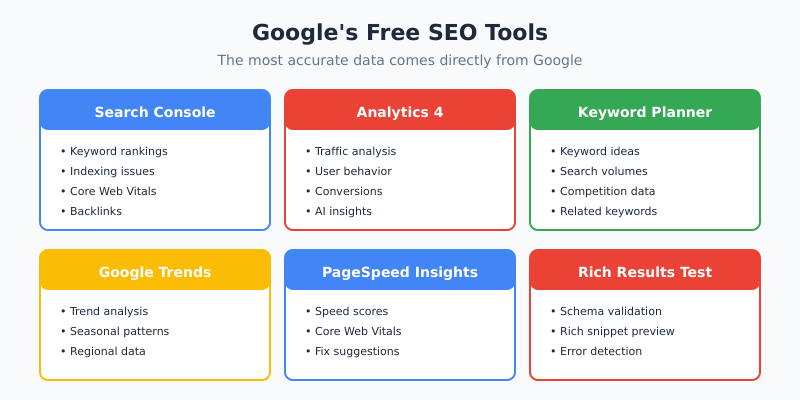
    Google’s Free SEO Tools

    Google offers the most powerful free SEO tools available. Since they run the search engine, their data is the most accurate you’ll find.

    Google's Free SEO Tools - Search Console, Analytics, PageSpeed

    1. Google Search Console

    Best for: Monitoring search performance, indexing issues, Core Web Vitals

    Google Search Console (GSC) is the single most important free SEO tool. It shows you exactly how Google sees your website.

    Key features:

    • See which keywords bring traffic to your site
    • Monitor click-through rates and average positions
    • Find and fix indexing problems
    • Submit sitemaps
    • Check Core Web Vitals scores
    • Identify mobile usability issues
    • See who links to your site

    No other tool gives you direct data from Google about your search performance. If you only use one SEO tool, make it this one.

    2. Google Analytics 4

    Best for: Traffic analysis, user behavior, conversions

    Google Analytics 4 (GA4) tracks everything that happens on your website. While not strictly an “SEO tool,” it’s essential for measuring whether your SEO efforts drive results.

    Key features:

    • Track organic traffic trends
    • See which pages perform best
    • Monitor user engagement metrics
    • Set up conversion tracking
    • AI-powered predictive analytics
    • Cross-platform tracking (web + app)

    3. Google Keyword Planner

    Best for: Keyword research, search volume data

    Google Keyword Planner is part of Google Ads, but you can use it for free without running ads. It provides keyword ideas and search volume estimates directly from Google.

    Key features:

    • Discover new keyword ideas
    • See monthly search volume ranges
    • Check keyword competition levels
    • Find related keywords
    • Filter by location and language

    Limitation: Shows volume ranges (like “1K-10K”) instead of exact numbers unless you’re running ads.

    4. Google Trends

    Best for: Trend analysis, seasonal keywords, topic research

    Google Trends shows how search interest changes over time. It’s invaluable for identifying trending topics and seasonal patterns.

    Key features:

    • Compare keyword popularity over time
    • Identify rising search trends
    • See regional interest differences
    • Find related queries and topics
    • Discover seasonal patterns

    5. PageSpeed Insights

    Best for: Page speed testing, Core Web Vitals

    PageSpeed Insights analyzes your page performance and provides specific recommendations for improvement.

    Key features:

    • Core Web Vitals scores (LCP, INP, CLS)
    • Field data from real users
    • Lab data for debugging
    • Specific optimization suggestions
    • Mobile and desktop scores

    6. Rich Results Test

    Best for: Structured data validation

    Rich Results Test checks if your structured data (Schema markup) is valid and eligible for rich results in search.

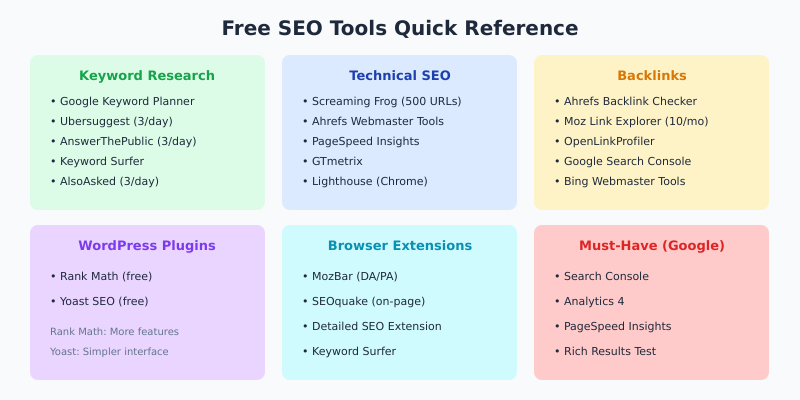
    Free Keyword Research Tools

    Free SEO Tools Quick Reference by Category

    Beyond Google’s tools, several free options help you find keywords and content ideas.

    7. Ubersuggest (Free Version)

    Best for: Keyword ideas, content suggestions, competitor analysis

    Ubersuggest by Neil Patel offers limited free searches per day. It provides keyword suggestions, search volume, difficulty scores, and content ideas.

    Free limits: 3 searches per day

    8. AnswerThePublic

    Best for: Question-based keywords, content ideas

    AnswerThePublic visualizes questions people ask about any topic. It’s excellent for finding long-tail keywords and FAQ content ideas.

    Free limits: 3 searches per day

    9. Keyword Surfer

    Best for: Quick keyword data while browsing

    Keyword Surfer is a free Chrome extension that shows search volume and related keywords directly in Google search results.

    Key features:

    • Search volume in the search bar
    • Related keyword suggestions
    • Word count of ranking pages
    • Estimated traffic of competitors

    10. AlsoAsked

    Best for: “People Also Ask” research

    AlsoAsked scrapes Google’s “People Also Ask” boxes to show related questions. Great for building comprehensive content that answers user intent.

    Free limits: 3 searches per day

    Free Technical SEO Tools

    Technical SEO requires specialized tools. Here are the best free options.

    11. Screaming Frog SEO Spider (Free Version)

    Best for: Site crawling, technical audits

    Screaming Frog is the industry-standard site crawler. The free version crawls up to 500 URLs — enough for most small to medium sites.

    Key features:

    • Find broken links (4xx errors)
    • Audit redirects
    • Analyze page titles and meta descriptions
    • Find duplicate content
    • Check robots.txt and canonicals
    • Generate XML sitemaps

    Free limits: 500 URLs, no JavaScript rendering

    12. Ahrefs Webmaster Tools

    Best for: Site audits, backlink monitoring

    Ahrefs Webmaster Tools (AWT) is surprisingly generous for a free tool. You get access to Site Audit and Site Explorer for sites you own.

    Key features:

    • Comprehensive site audits
    • Backlink profile analysis
    • Organic keyword rankings
    • Health score monitoring
    • Technical issue detection

    Limitation: Only for verified sites you own

    13. Bing Webmaster Tools

    Best for: Bing SEO, additional insights

    Bing Webmaster Tools offers similar features to GSC plus unique tools like built-in keyword research and SEO reports with actionable guidance.

    Don’t ignore Bing — it powers about 9% of searches and also feeds data to DuckDuckGo and other search engines.

    14. GTmetrix

    Best for: Page speed analysis, waterfall charts

    GTmetrix provides detailed performance reports with waterfall charts showing exactly what slows down your pages.

    Free limits: Tests from Vancouver server only, basic analysis

    15. Chrome DevTools Lighthouse

    Best for: Performance audits, accessibility, best practices

    Built into Chrome (press F12 → Lighthouse tab), this tool audits performance, accessibility, best practices, and SEO. It’s the same engine that powers PageSpeed Insights.

    Free Backlink Analysis Tools

    Backlinks remain a crucial ranking factor. These tools help you analyze link profiles without paying.

    16. Ahrefs Backlink Checker

    Best for: Quick backlink overview

    Ahrefs Backlink Checker shows the top 100 backlinks for any domain. Useful for quick competitor analysis.

    17. Moz Link Explorer

    Best for: Domain Authority, link metrics

    Moz Link Explorer offers 10 free queries per month. It shows Domain Authority, linking domains, and top pages.

    18. OpenLinkProfiler

    Best for: Detailed backlink analysis (unlimited)

    OpenLinkProfiler is completely free with no daily limits. It provides detailed backlink data including anchor text, link context, and freshness.

    Free WordPress SEO Plugins

    If you use WordPress, these plugins handle on-page SEO without additional tools.

    19. Yoast SEO

    Best for: On-page optimization, readability

    Yoast SEO is the most popular WordPress SEO plugin with over 5 million active installations. The free version covers all essential on-page SEO needs.

    Key features:

    • Focus keyword optimization
    • Readability analysis
    • XML sitemap generation
    • Meta title and description templates
    • Breadcrumb navigation
    • Schema markup (basic)

    20. Rank Math

    Best for: Advanced features in free version

    Rank Math offers more features in its free version than most competitors’ paid versions. It’s become the go-to alternative to Yoast.

    Key features (free):

    • Multiple focus keywords (up to 5)
    • Advanced Schema markup
    • Google Search Console integration
    • 404 error monitoring
    • Redirection manager
    • Local SEO features

    Free SEO Browser Extensions

    These extensions add SEO functionality directly to your browser.

    21. MozBar

    Best for: Quick metrics while browsing

    MozBar displays Domain Authority, Page Authority, and spam scores for any page you visit. Essential for quick competitive analysis.

    22. SEOquake

    Best for: Comprehensive on-page analysis

    SEOquake by SEMrush provides detailed SEO metrics including keyword density, internal/external links, and social metrics.

    23. Detailed SEO Extension

    Best for: Technical on-page checks

    Detailed SEO Extension shows headings, links, images, Schema, and more in a clean interface. Lightweight and fast.

    Free SERP & Rank Tracking Tools

    24. SERP Simulator

    Best for: Previewing how your page appears in search

    SERP Simulator shows exactly how your title and description will appear in Google search results. Helps you optimize for clicks.

    25. Whatsmyserp

    Best for: Free rank tracking

    Whatsmyserp offers free daily rank tracking for up to 25 keywords. Simple but effective for monitoring your most important terms.

    Bonus: Free Schema & Structured Data Tools

    26. Schema Markup Generator

    Best for: Creating structured data

    Schema Markup Generator by TechnicalSEO.com helps you create JSON-LD Schema markup for articles, products, FAQs, and more without coding.

    27. Schema.org Validator

    Best for: Validating any Schema markup

    Schema.org Validator tests your structured data against the official Schema.org specifications.

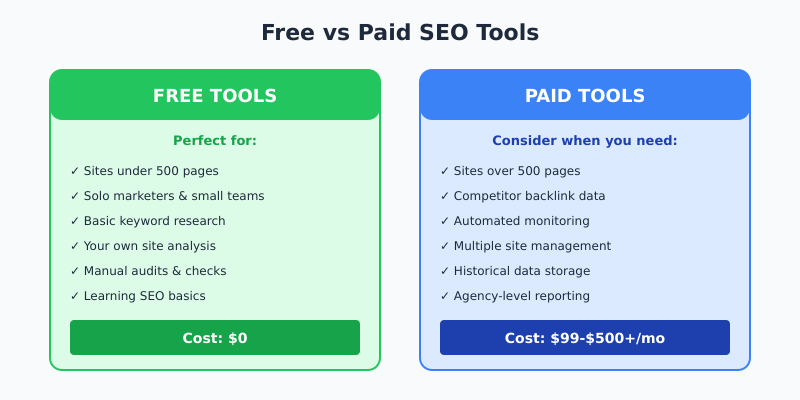
    Free vs Paid: When to Upgrade

    Free vs Paid SEO Tools Comparison

    Free tools cover most SEO needs, but consider paid tools when:

    • Your site exceeds 500 pages — Screaming Frog’s free version won’t crawl it all
    • You need competitor backlink data — Free tools only show limited data
    • You want automated monitoring — Free tools require manual checks
    • You manage multiple sites — Paid tools scale better
    • You need historical data — Most free tools don’t store history

    For most small to medium websites and solo marketers, free tools are more than enough to compete effectively.

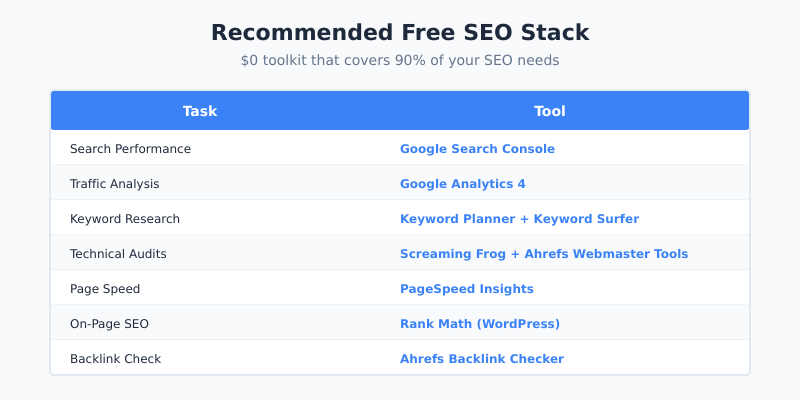
    My Recommended Free SEO Stack

    Recommended Free SEO Stack - $0 Toolkit

    If you’re just starting out, here’s my recommended combination of free tools:

    TaskTool
    Search performanceGoogle Search Console
    Traffic analysisGoogle Analytics 4
    Keyword researchGoogle Keyword Planner + Keyword Surfer
    Technical auditsScreaming Frog + Ahrefs Webmaster Tools
    Page speedPageSpeed Insights
    On-page SEORank Math (WordPress)
    Backlink checkAhrefs Backlink Checker

    This stack costs $0 and covers 90% of what you need to rank well in 2026.

    FAQ

    What is the best free SEO tool overall?

    Google Search Console. It provides the most accurate data about how Google sees your site, including keyword rankings, indexing issues, and Core Web Vitals. No other free (or paid) tool can match its accuracy for this data.

    Are free SEO tools good enough for professionals?

    Yes, for many tasks. I use free tools like Google Search Console, Screaming Frog, and PageSpeed Insights daily in my professional work. Paid tools are mainly needed for competitive analysis, large-scale projects, or automation.

    What’s the best free alternative to Ahrefs or SEMrush?

    There’s no single free tool that matches their full functionality. However, combining Ahrefs Webmaster Tools (for your own sites), Ubersuggest, and Google Search Console provides similar core capabilities for free.

    Which free keyword research tool is most accurate?

    Google Keyword Planner provides the most accurate data since it comes directly from Google. The downside is that it shows volume ranges instead of exact numbers. For exact volumes, Keyword Surfer and Ubersuggest are good free options, though less precise.

    Is Yoast SEO or Rank Math better?

    Rank Math’s free version offers more features (multiple focus keywords, advanced Schema, redirect manager). Yoast is more established with a simpler interface. Both are excellent — I recommend Rank Math for power users and Yoast for beginners.

    Final Thoughts

    You don’t need expensive tools to do SEO well. The free tools in this list — especially Google’s own tools — provide everything you need to research keywords, audit your site, track rankings, and improve performance.

    Start with Google Search Console and Analytics. Add Screaming Frog for technical audits and Rank Math for WordPress optimization. As your needs grow, you can selectively add paid tools for specific gaps.

    The best SEO tool is the one you actually use. Pick a few from this list and master them before adding more. Quality over quantity.

    I use most of these tools in my daily work. This list reflects real-world testing and over a decade of SEO experience.

  • How to Do a Technical SEO Audit in 2026 (Step-by-Step)

    How to Do a Technical SEO Audit in 2026 (Step-by-Step)

    A technical SEO audit is the foundation of any successful SEO strategy. Without it, you’re optimizing blindly — hoping content improvements will work while hidden technical issues silently tank your rankings.

    I’ve performed hundreds of technical audits over the past 10 years. Some sites had obvious issues. Others looked fine on the surface but had crawlability problems that blocked 40% of their pages from Google’s index.

    This guide walks you through a complete technical SEO audit — step by step. You’ll learn exactly what to check, which tools to use (mostly free), and how to prioritize fixes that actually move the needle.

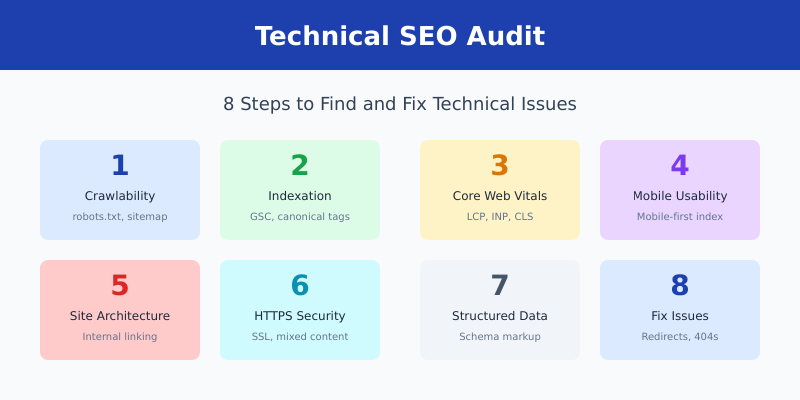
    Technical SEO Audit - 8 Steps to Find and Fix Technical Issues

    What Is a Technical SEO Audit?

    A technical SEO audit analyzes your website’s infrastructure to identify issues that prevent search engines from crawling, indexing, and ranking your pages effectively.

    Unlike content audits (which focus on keywords and quality) or backlink audits (which analyze your link profile), technical audits focus on:

    • Crawlability — Can search engines access your pages?
    • Indexability — Are your pages being added to Google’s index?
    • Site speed — Do pages load fast enough for users and Google?
    • Mobile experience — Does your site work well on phones?
    • Site architecture — Is your internal linking structure logical?
    • Security — Is HTTPS properly implemented?

    Tools You’ll Need

    Good news: you can perform a thorough technical audit with mostly free tools. Here’s what I use:

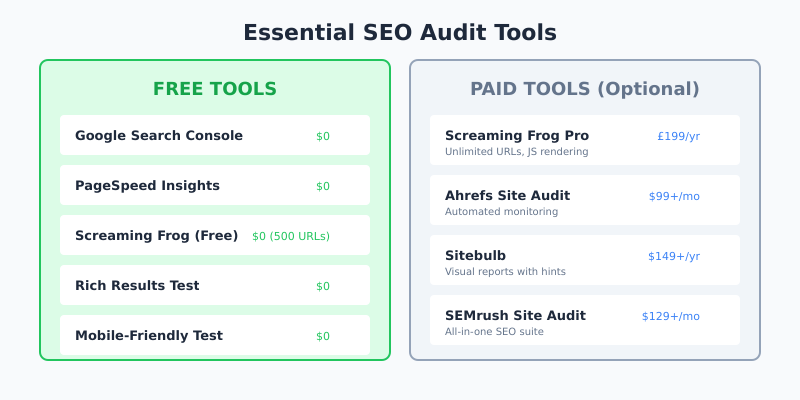
    Essential SEO Audit Tools - Free and Paid Options

    Free Tools

    ToolPurposeCost
    Google Search ConsoleIndexing, crawl errors, Core Web VitalsFree
    PageSpeed InsightsPerformance testing, Core Web VitalsFree
    Screaming Frog (free version)Crawl up to 500 URLsFree
    Mobile-Friendly TestMobile usability checkFree
    Rich Results TestStructured data validationFree

    Paid Tools (Optional)

    For larger sites or deeper analysis:

    • Screaming Frog (£199/year) — Unlimited crawling, JS rendering
    • Ahrefs Site Audit ($99+/month) — Automated monitoring
    • Sitebulb ($149+/year) — Visual reports with hints

    Step 1: Check Crawlability

    If Google can’t crawl your pages, nothing else matters. Start here.

    Review robots.txt

    Your robots.txt file tells search engines what they can and can’t crawl. Check it at yoursite.com/robots.txt.

    Look for:

    • Accidental Disallow: / blocking your entire site
    • Important directories being blocked (like /blog/ or /products/)
    • CSS/JS files being blocked (breaks rendering)
    • Missing or incorrect sitemap reference

    Check XML Sitemap

    Your sitemap helps Google discover pages. Usually at yoursite.com/sitemap.xml.

    Verify:

    • Sitemap exists and is accessible
    • All important pages are included
    • No 404 or redirected URLs in sitemap
    • Sitemap is submitted in Google Search Console
    • Last modified dates are accurate

    Run a Crawl

    Use Screaming Frog (free for up to 500 URLs) to crawl your site. This reveals:

    • Broken links (4xx errors)
    • Server errors (5xx errors)
    • Redirect chains and loops
    • Orphan pages (no internal links pointing to them)
    • Crawl depth issues

    Step 2: Analyze Indexation

    Crawlability ≠ indexability. Google might crawl a page but choose not to index it.

    Check Index Coverage in GSC

    In Google Search Console, go to Pages (formerly Index Coverage). Look for:

    • Not indexed pages — Why are they excluded?
    • “Crawled – currently not indexed” — Google found it but didn’t think it was worth indexing
    • “Discovered – currently not indexed” — Google knows about it but hasn’t crawled yet
    • Duplicate pages — Canonicalization issues

    Review Meta Robots Tags

    Check that important pages don’t have noindex tags blocking indexation.

    In Screaming Frog, filter by “Noindex” to find pages accidentally blocked. Common culprits:

    • Staging site settings left on after launch
    • CMS plugins adding noindex to pagination
    • Developer testing not reverted

    Check Canonical Tags

    Canonical tags tell Google which version of a page is the “master.” Problems occur when:

    • Pages canonical to themselves incorrectly
    • Canonicals point to non-existent pages
    • HTTP pages canonical to HTTPS (or vice versa)
    • Multiple canonical tags on one page

    Step 3: Audit Core Web Vitals

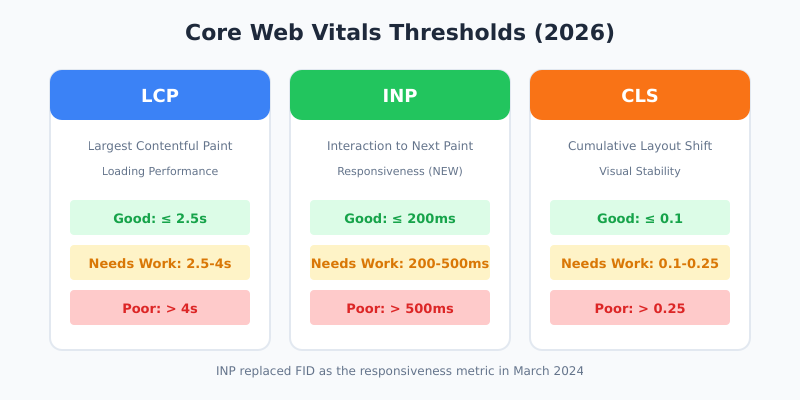
    Core Web Vitals are Google’s page experience metrics. In 2024, INP (Interaction to Next Paint) replaced FID as the responsiveness metric.

    Core Web Vitals Thresholds 2026 - LCP, INP, CLS

    The Three Metrics

    MetricWhat It MeasuresGood Score
    LCPLoading performance≤ 2.5 seconds
    INPResponsiveness to interactions≤ 200 milliseconds
    CLSVisual stability≤ 0.1

    How to Check

    Field data (real users):

    • Google Search Console → Core Web Vitals report
    • PageSpeed Insights → “Field Data” section

    Lab data (simulated):

    • PageSpeed Insights → “Lab Data” section
    • Chrome DevTools → Lighthouse

    Focus on field data — that’s what Google uses for ranking.

    Common Issues and Fixes

    Poor LCP:

    • Optimize largest image (compress, use WebP)
    • Preload critical resources
    • Reduce server response time (TTFB)
    • Remove render-blocking resources

    Poor INP:

    • Reduce JavaScript execution time
    • Break up long tasks
    • Optimize event handlers
    • Reduce main thread work

    Poor CLS:

    • Set explicit dimensions on images/videos
    • Reserve space for ads and embeds
    • Avoid inserting content above existing content
    • Use CSS transforms instead of layout-changing properties

    Step 4: Check Mobile Usability

    Google uses mobile-first indexing — your mobile site is what gets ranked. Over 60% of searches happen on mobile devices.

    Mobile Usability Report

    In Google Search Console, check the Mobile Usability report for issues like:

    • Text too small to read (minimum 16px)
    • Clickable elements too close together (minimum 44px tap targets)
    • Content wider than screen
    • Viewport not configured

    Manual Testing

    Don’t just rely on tools. Actually use your site on a phone:

    • Can you navigate easily?
    • Do forms work properly?
    • Are images properly sized?
    • Does the menu function correctly?

    Step 5: Audit Site Architecture

    Good site architecture helps users and search engines find content efficiently.

    Check Crawl Depth

    Important pages should be reachable within 3 clicks from the homepage. In Screaming Frog, check the “Crawl Depth” column.

    Guidelines:

    • Homepage = depth 0
    • Main categories = depth 1
    • Subcategories/posts = depth 2-3
    • Anything deeper than 4 may struggle to rank

    Internal Linking

    Internal links distribute “link equity” and help Google understand page relationships.

    Check for:

    • Orphan pages — pages with no internal links pointing to them
    • Broken internal links — links pointing to 404 pages
    • Important pages with few links — your best content should have the most internal links

    URL Structure

    URLs should be clean, descriptive, and consistent:

    • Use hyphens, not underscores
    • Keep URLs short and readable
    • Include target keywords naturally
    • Avoid unnecessary parameters
    • Use lowercase only

    Step 6: Review HTTPS and Security

    HTTPS is a ranking factor and essential for user trust.

    HTTPS Checklist

    • SSL certificate is valid and not expired
    • All pages redirect HTTP → HTTPS
    • No mixed content warnings (HTTP resources on HTTPS pages)
    • Internal links use HTTPS
    • Canonical tags use HTTPS
    • Sitemap uses HTTPS URLs

    Step 7: Check Structured Data

    Structured data (Schema markup) helps Google understand your content and can enable rich results in search.

    Common Schema Types

    • Article — for blog posts
    • Product — for e-commerce
    • FAQ — for FAQ sections
    • HowTo — for tutorials
    • LocalBusiness — for local SEO
    • Review — for review content

    How to Validate

    Use Google’s Rich Results Test to check for errors. Common issues:

    • Missing required properties
    • Invalid values
    • Markup not matching visible content

    Step 8: Identify and Fix Technical Issues

    Finally, clean up the common technical problems that accumulate on every site.

    Broken Links (4xx Errors)

    Broken links hurt user experience and waste crawl budget. Fix by:

    • Updating links to correct URLs
    • Setting up 301 redirects for deleted pages
    • Removing links to pages that no longer exist

    Redirect Issues

    Redirect chains: A → B → C should be A → C
    Redirect loops: A → B → A (breaks crawling)
    Temporary redirects (302): Use 301 for permanent moves

    Duplicate Content

    Duplicate content confuses Google about which page to rank. Common causes:

    • HTTP and HTTPS versions both accessible
    • www and non-www versions both accessible
    • URL parameters creating duplicate pages
    • Pagination issues

    Fix with: canonical tags, 301 redirects, or parameter handling in GSC.

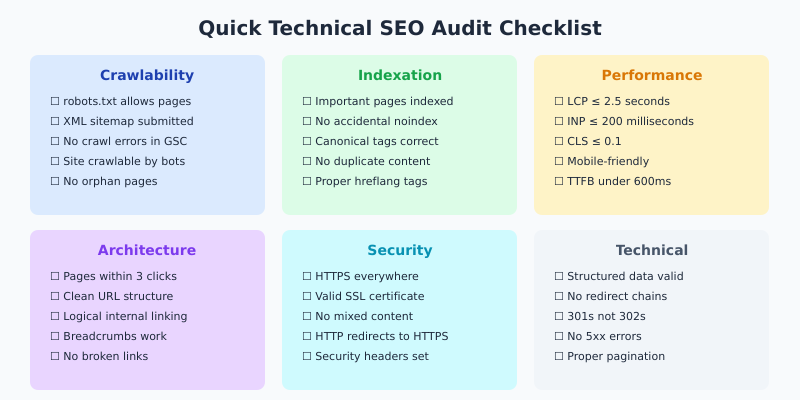
    Technical SEO Audit Checklist

    Here’s a quick reference checklist you can use for every audit:

    Quick Technical SEO Audit Checklist

    Crawlability

    • ☐ robots.txt allows important pages
    • ☐ XML sitemap exists and is submitted
    • ☐ No crawl errors in GSC
    • ☐ Site is crawlable (test with Screaming Frog)

    Indexation

    • ☐ Important pages are indexed
    • ☐ No accidental noindex tags
    • ☐ Canonical tags are correct
    • ☐ No duplicate content issues

    Performance

    • ☐ LCP ≤ 2.5 seconds
    • ☐ INP ≤ 200 milliseconds
    • ☐ CLS ≤ 0.1
    • ☐ Mobile-friendly

    Architecture

    • ☐ Important pages within 3 clicks
    • ☐ No orphan pages
    • ☐ Clean URL structure
    • ☐ Logical internal linking

    Security & Technical

    • ☐ HTTPS properly implemented
    • ☐ No mixed content
    • ☐ No broken links
    • ☐ No redirect chains/loops
    • ☐ Structured data validates

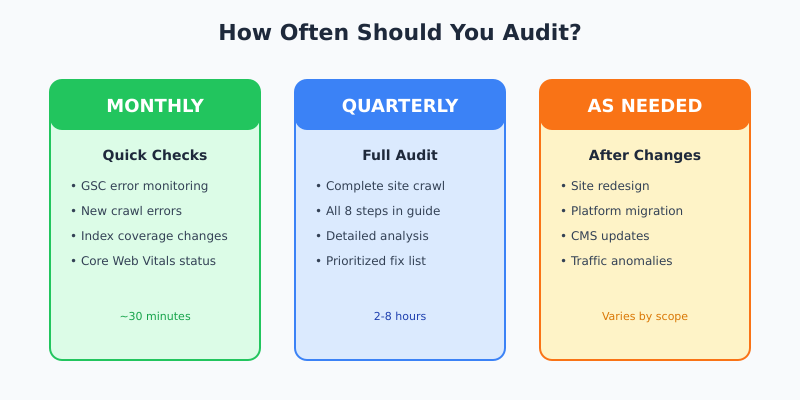
    How Often Should You Audit?

    How Often Should You Audit - Monthly, Quarterly, As Needed

    Monthly: Quick checks in GSC for new errors
    Quarterly: Full technical audit
    After major changes: Site redesign, migration, CMS update

    Set up monitoring in Google Search Console to catch issues as they appear, rather than waiting for the next scheduled audit.

    FAQ

    How long does a technical SEO audit take?

    For a small site (under 500 pages), expect 2-4 hours. Medium sites (500-5,000 pages) take 4-8 hours. Large enterprise sites can take days to audit thoroughly. The crawl itself might take hours for very large sites.

    Can I do a technical SEO audit without paid tools?

    Yes. Google Search Console, PageSpeed Insights, and Screaming Frog’s free version (500 URL limit) cover most needs. You’ll only need paid tools for sites larger than 500 pages or advanced features like JavaScript rendering.

    What’s the most important thing to fix first?

    Crawlability and indexation issues. If Google can’t crawl or index your pages, nothing else matters. Fix robots.txt blocks, noindex tags, and major crawl errors before worrying about page speed or structured data.

    Do I need to hire an SEO agency for a technical audit?

    Not necessarily. If you’re comfortable with the tools and concepts in this guide, you can do it yourself. However, for large or complex sites — especially e-commerce or enterprise — professional help can save time and catch issues you might miss.

    What’s the difference between technical SEO and on-page SEO?

    Technical SEO focuses on site infrastructure: crawlability, indexation, speed, and architecture. On-page SEO focuses on content optimization: keywords, titles, meta descriptions, and content quality. Both are essential — technical SEO creates the foundation for on-page efforts to succeed.

    Final Thoughts

    A technical SEO audit isn’t a one-time project — it’s an ongoing process. Sites change, content gets added, plugins get updated, and technical debt accumulates.

    The good news: once you’ve done a thorough initial audit and fixed the major issues, maintenance is much easier. Set up monitoring, do quarterly check-ins, and address problems as they arise.

    Start with crawlability — that’s the foundation. Then work through indexation, Core Web Vitals, and the other checks in this guide. Prioritize issues that affect the most pages or your most important content.

    Technical SEO isn’t glamorous, but it’s often the difference between sites that rank and sites that don’t.

    I perform technical audits for clients regularly. This guide reflects real-world experience from hundreds of site audits over 10+ years.

  • Screaming Frog Pricing Explained: Is the Paid Version Worth It? (2026)

    Screaming Frog Pricing Explained: Is the Paid Version Worth It? (2026)

    If you’ve spent any time doing technical SEO, you’ve probably heard of Screaming Frog SEO Spider. It’s the go-to desktop crawler for SEO professionals worldwide. But here’s the question I get asked all the time: is the paid version worth $259 per year when there’s a free version available?

    I’ve been using Screaming Frog for over 7 years now. I’ve crawled thousands of websites with both the free and paid versions. In this article, I’ll break down exactly what you get with each option, the hidden limitations of the free version, and help you decide if upgrading makes sense for your situation.

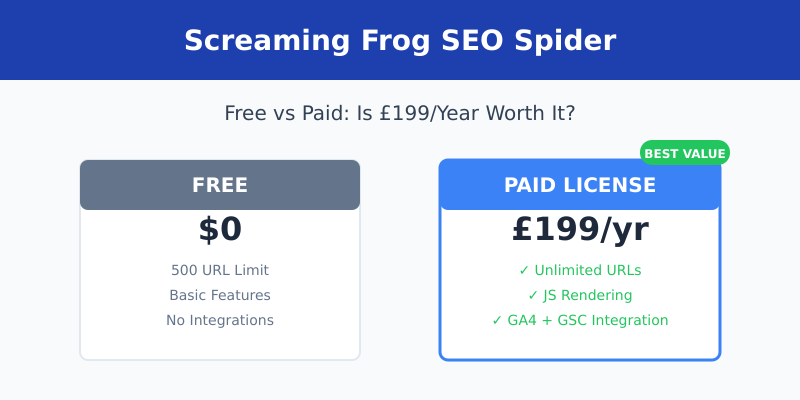
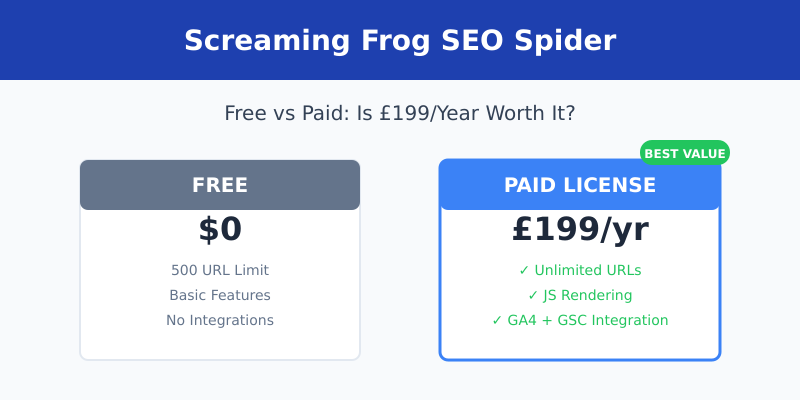
    Screaming Frog free vs paid pricing comparison showing £199/year for unlimited features

    Screaming Frog Pricing Overview

    Let’s start with the basics. Screaming Frog offers two pricing tiers:

    VersionPriceURL LimitBest For
    Free$0500 URLsSmall sites, quick audits
    Paid License£199/year (~$259)UnlimitedProfessional SEO work

    The paid license is billed annually. There’s no monthly option, which can be a barrier for freelancers just starting out. However, if you purchase 5 or more licenses, you get bulk discounts — useful for agencies.

    What the Free Version Actually Includes

    The free version of Screaming Frog is genuinely useful — not a crippled demo. Here’s what you can do without paying anything:

    • Crawl up to 500 URLs per crawl
    • Find broken links (4xx and 5xx errors)
    • Analyze page titles and meta descriptions
    • Find duplicate content issues
    • Check redirect chains
    • Review heading structure (H1, H2, etc.)
    • Identify missing alt text on images
    • Export basic reports

    For a small blog or portfolio site under 500 pages, this is often enough. I still use the free version for quick sanity checks on smaller client sites.

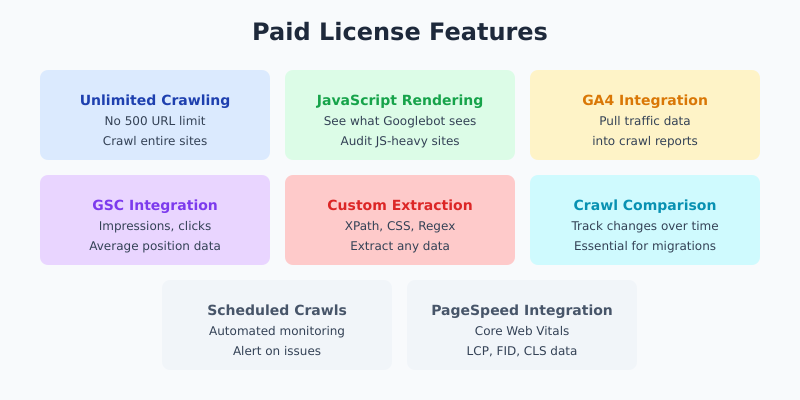
    What You Unlock with the Paid License

    Here’s where things get interesting. The paid version doesn’t just remove the URL limit — it adds features that fundamentally change how you can use the tool.

    Screaming Frog paid license features including unlimited crawling, JavaScript rendering, and integrations

    Unlimited Crawling

    The 500 URL limit sounds reasonable until you realize how quickly you hit it. A typical e-commerce site with product pages, category pages, and blog posts can easily have 5,000-50,000+ URLs. Even a medium-sized business site often exceeds 500 pages when you count all the subpages.

    JavaScript Rendering

    This is the feature I use most. Modern websites rely heavily on JavaScript to load content. Without JS rendering, Screaming Frog only sees the raw HTML — missing dynamically loaded content, navigation menus, and sometimes entire page sections.

    With the paid version, you can render JavaScript just like Googlebot does. This is essential for auditing React, Vue, Angular, or any JS-heavy site.

    Google Analytics Integration

    Connect your GA4 account directly to Screaming Frog. This lets you pull traffic data, bounce rates, and engagement metrics directly into your crawl. You can quickly identify pages that get traffic but have technical issues, or pages with zero traffic that might need attention.

    Google Search Console Integration

    Similarly, you can connect GSC to see impressions, clicks, and average position for each URL. This turns Screaming Frog from a technical crawler into a strategic SEO tool. I use this constantly to find pages ranking on page 2 that need optimization.

    PageSpeed Insights Integration

    Pull Core Web Vitals data (LCP, FID, CLS) directly into your crawl. No more checking pages one by one in PageSpeed Insights. You can audit an entire site’s performance in one go.

    Custom Extraction

    Extract any data from pages using XPath, CSS selectors, or regex. I use this to pull:

    • Product prices from e-commerce sites
    • Author names from blog posts
    • Schema markup data
    • Custom tracking codes
    • Any element you need to audit at scale

    Crawl Comparison

    Save crawls and compare them over time. This is invaluable for site migrations. I’ve used this feature to verify that hundreds of redirects were implemented correctly and no pages were accidentally dropped.

    Scheduled Crawls

    Set up automated crawls that run on a schedule. Get alerts when issues appear. This turns Screaming Frog into a monitoring tool, not just an audit tool.

    Free vs Paid: Complete Feature Comparison

    FeatureFreePaid (£199/yr)
    URL crawl limit500Unlimited
    Broken link checking
    Title/meta analysis
    JavaScript rendering
    Google Analytics integration
    Search Console integration
    PageSpeed integration
    Custom extraction
    Crawl comparison
    Scheduled crawls
    Save crawls
    XML sitemap generation
    AMP validation
    Structured data validation

    Hidden Costs to Consider

    The license fee is straightforward, but there are a few hidden costs:

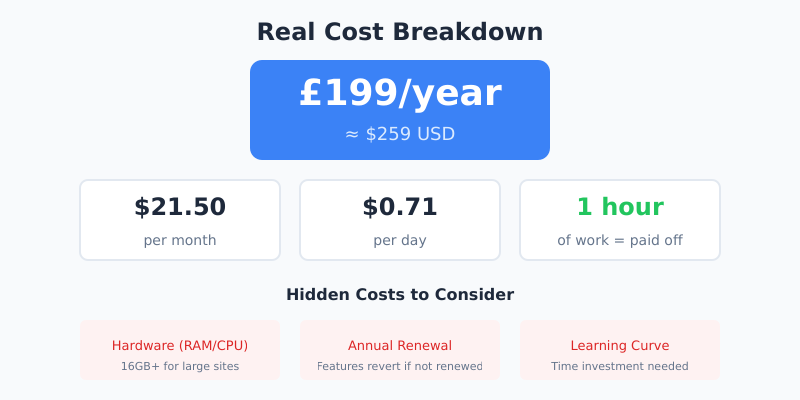
    Screaming Frog real cost breakdown showing £199/year equals $21.50/month or $0.71/day

    Hardware Requirements

    Screaming Frog runs on your computer, using your RAM and CPU. Crawling large sites (50,000+ URLs) with JavaScript rendering requires serious hardware. I recommend:

    • Minimum: 8GB RAM for sites under 10,000 URLs
    • Recommended: 16GB+ RAM for larger sites
    • JavaScript rendering: Even more RAM and a decent CPU

    If your laptop struggles with large crawls, that’s an indirect cost of the tool.

    Annual Renewal

    The license is annual. If you don’t renew, you keep the software but lose access to updates and the paid features revert to free-version limits. You’re essentially renting the advanced features.

    Learning Curve

    Screaming Frog has a steep learning curve. It’s not a tool you’ll master in an afternoon. Budget time for learning, or you won’t get full value from your investment.

    Is It Worth the Price? My Honest Assessment

    Here’s my take after 7+ years of using Screaming Frog professionally:

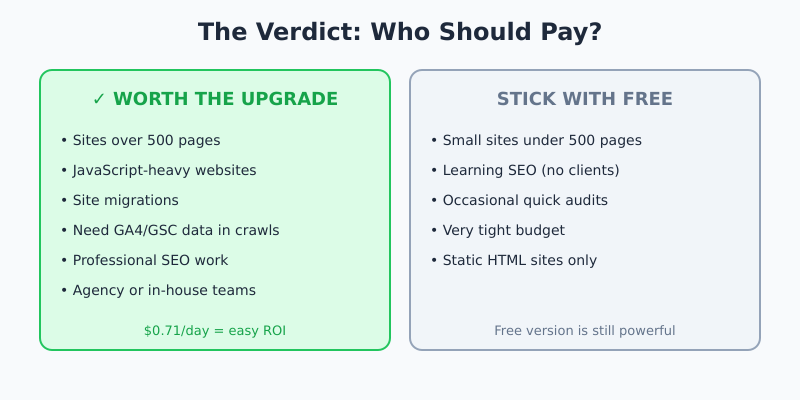
    Screaming Frog verdict showing who should upgrade vs stick with free version

    The paid version is absolutely worth it if:

    • You work with sites over 500 pages (most business sites)
    • You audit JavaScript-heavy websites
    • You handle site migrations
    • You want to combine crawl data with analytics/GSC data
    • You do SEO professionally (in-house or agency)

    At roughly $259/year, it works out to about $21.50 per month or $0.71 per day. If you bill even one hour of SEO work per month, the tool pays for itself many times over.

    Stick with the free version if:

    • You only manage small sites under 500 pages
    • You’re learning SEO and not doing client work yet
    • You only need occasional quick audits
    • Budget is extremely tight and you can’t justify any tool costs

    Screaming Frog vs Alternatives

    How does Screaming Frog compare to other options?

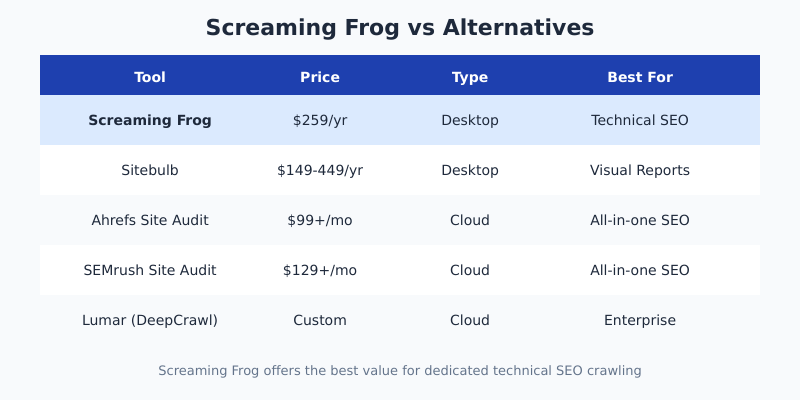
    Screaming Frog vs Sitebulb, Ahrefs, SEMrush and Lumar pricing comparison table
    ToolPriceTypeBest For
    Screaming Frog$259/yrDesktopTechnical SEO audits
    Sitebulb$149-449/yrDesktopVisual reports, hints
    Ahrefs Site Audit$99+/moCloudAll-in-one SEO suite
    SEMrush Site Audit$129+/moCloudAll-in-one SEO suite
    Lumar (DeepCrawl)Custom pricingCloudEnterprise sites

    Screaming Frog offers the best value for dedicated technical SEO crawling. Sitebulb is a worthy alternative with better visualizations. Cloud tools like Ahrefs and SEMrush include crawling but cost significantly more and aren’t as deep for technical audits.

    Tips to Get the Most Value from Your License

    If you decide to buy, here’s how to maximize your ROI:

    1. Learn the integrations — Connect GA4 and GSC immediately. This alone transforms the tool’s usefulness.
    2. Master custom extraction — Spend time learning XPath. You’ll find uses you never imagined.
    3. Save crawl configurations — Create templates for different audit types. Saves hours over time.
    4. Use crawl comparison for migrations — This feature alone can justify the cost for agency work.
    5. Allocate enough RAM — In settings, increase memory allocation for faster, more complete crawls.

    FAQ

    Is Screaming Frog free?

    Yes, there’s a free version that crawls up to 500 URLs with basic features. It’s fully functional for small sites but lacks advanced features like JavaScript rendering, API integrations, and the ability to save crawls.

    How much does Screaming Frog cost per year?

    The paid license costs £199 per year (approximately $259 USD). There’s no monthly option. Bulk discounts are available when purchasing 5 or more licenses, making it more affordable for agencies.

    Can I use Screaming Frog on multiple computers?

    Each license is valid for one machine. If you need to use Screaming Frog on multiple computers, you’ll need separate licenses. However, you can deactivate and reactivate on a different machine if needed.

    What’s the best Screaming Frog alternative?

    Sitebulb is the closest alternative for desktop crawling, offering better visualizations at similar pricing. For cloud-based crawling, Ahrefs and SEMrush include site audit tools but cost more and focus on broader SEO features.

    Is Screaming Frog good for beginners?

    Screaming Frog has a steep learning curve due to its technical nature and extensive features. Beginners can use the free version to learn, but expect to invest time in tutorials. Sitebulb offers a more beginner-friendly interface with guided hints.

    Final Verdict

    Screaming Frog SEO Spider remains one of the best investments in my SEO toolkit. At $259/year, it’s a fraction of what cloud-based SEO suites charge, and nothing else matches its depth for technical crawling.

    If you’re doing SEO professionally — whether in-house, freelance, or agency — the paid version pays for itself quickly. The GA4/GSC integrations alone save hours of manual work. The JavaScript rendering is essential for modern web audits. And crawl comparison is indispensable for migrations.

    Start with the free version to learn the interface. Once you hit that 500 URL limit on a real project, you’ll understand exactly why the upgrade is worth it.

    I buy and test all tools myself. This review is based on 7+ years of professional use across hundreds of client sites.